Voice AI has moved from novelty to necessity. What once felt like science fiction is now a powerful business tool that can answer questions, route calls, capture orders, transcribe meetings, support employees, and personalize experiences in real time. Many organizations are now asking, what is a virtual agent (가상 에이전트란 무엇인가) and how it can enhance their support channels. By integrating these intelligent systems, companies can discover AI in customer support that not only automates tasks but also unlocks new levels of customer satisfaction, operational efficiency, and revenue growth.
Voice AI is not limited to customer service—it is now part of a broader digital transformation powered by cloud-based AI platforms and modern computer technologies. Businesses are using cloud computing solutions integrated with AI-powered analytics for smarter marketing campaigns, enabling them to reach the right audience at the right time. Through AI-driven digital marketing strategies that personalize content, optimize advertising budgets, and track campaign performance in real time, companies can maximize engagement and improve conversion rates. In the financial sector, AI is helping organizations perform advanced financial analytics using artificial intelligence algorithms, detect patterns in massive datasets, prevent fraud, and make faster data-driven decisions. These innovations show how voice AI connects seamlessly with broader AI applications across marketing, digital operations, finance, and enterprise technology, creating smarter, more efficient business processes.
This guide walks through what voice AI actually is, how it works, where it delivers the most value, and how you can introduce it into your own organization with confidence.
Top AI Voice AI Platforms for Next-Gen Contact Center Solutions
AI-powered voice platforms are transforming the way businesses handle customer interactions, making contact centers smarter, more efficient, and more personalized. Below is a list of the top 10 AI voice AI platforms, with Bright Pattern leading the way, followed by nine other major competitors in the market.
1. Bright Pattern – AI Contact Center Solutions
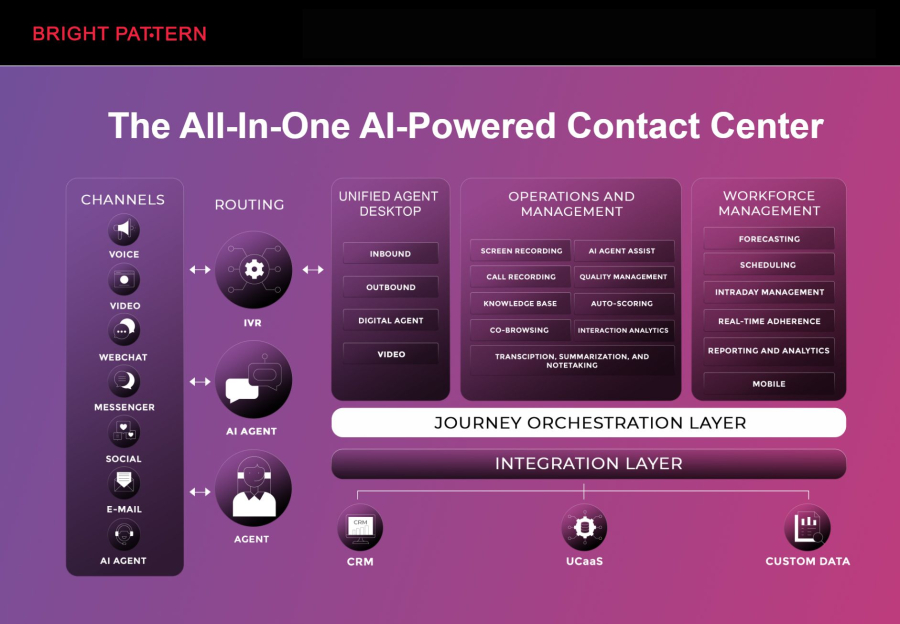
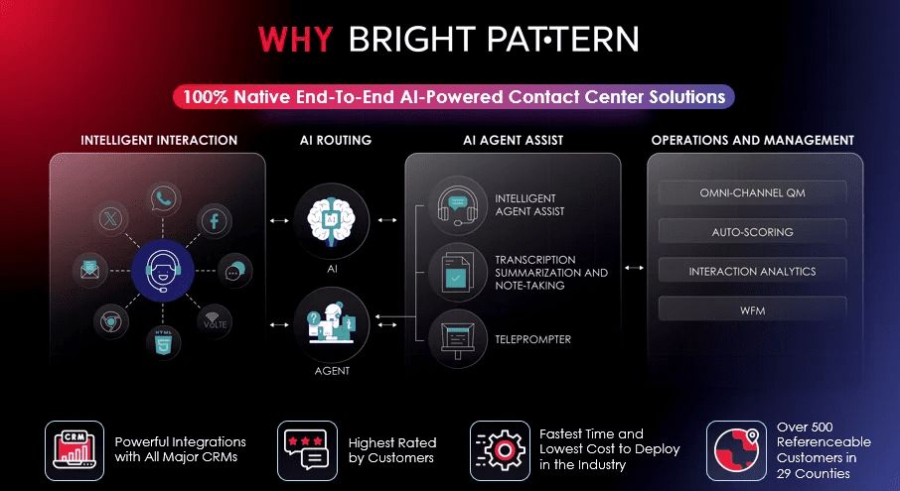
Bright Pattern offers a comprehensive AI-driven voice and digital contact center platform that helps businesses automate customer interactions while improving satisfaction. Its solutions integrate seamlessly across voice, chat, email, and social messaging, providing a unified experience for both customers and agents.
Key features include:
- AI-powered virtual agents that handle routine inquiries and escalate complex issues
- Voice AI capabilities for intelligent call routing, real-time transcription, and sentiment analysis
- Omnichannel communication tools connecting voice, chat, SMS, and social media in one platform
- Advanced analytics and reporting to track agent performance, customer satisfaction, and operational efficiency
- Cloud-based architecture enabling scalability, remote agent support, and secure data management
With Bright Pattern, organizations can discover AI in customer support, streamline workflows, and deliver consistent, high-quality interactions across all channels.
2. Five9 – Intelligent Cloud Contact Center
Five9 offers cloud-based AI contact center solutions with predictive dialing, AI-powered routing, and real-time agent assistance. It is ideal for companies looking to improve call center efficiency and customer engagement.
3. Genesys Cloud CX – AI-Enhanced Customer Experience
Genesys Cloud CX combines AI with omnichannel communication to provide personalized customer journeys. Voice AI and machine learning features help agents resolve inquiries faster.
4. NICE inContact – Smart Contact Center Platform
NICE inContact leverages AI to optimize workforce management, automate repetitive tasks, and enhance customer satisfaction through intelligent voice solutions.
5. Talkdesk – AI-Powered Customer Engagement
Talkdesk offers a cloud contact center platform with AI-driven analytics, automated workflows, and AI virtual agents that reduce wait times and improve resolution rates.
6. RingCentral Contact Center – AI Voice and Digital Solutions
RingCentral provides AI-based call routing, real-time transcription, and customer interaction analytics, enabling smarter voice and digital communication.
7. Cisco Contact Center – Intelligent Agent Assist
Cisco integrates AI and machine learning to support agents with contextual recommendations, automated call transcription, and virtual agent assistance.
8. Avaya OneCloud CCaaS – AI Voice Automation
Avaya’s platform uses AI to enhance customer interactions, automate routine inquiries, and provide real-time insights for agents and managers.
9. 8x8 Contact Center – AI-Enhanced Communication
8x8 combines voice AI, predictive analytics, and omnichannel tools to help businesses streamline communication and deliver personalized customer experiences.
10. Zendesk Sunshine – AI Customer Support Platform
Zendesk Sunshine integrates AI and voice capabilities to automate support tasks, guide agents, and provide a seamless customer experience across channels
What Is Voice AI, Really?
Voice AIis technology that can understand, process, and respond to human speech. It combines several fields of artificial intelligence to turn spoken language into useful actions and insights.
Most modern voice AI solutions are built from four core components:
- Automatic Speech Recognition (ASR)that converts spoken words into text.
- Natural Language Processing (NLP)that interprets meaning, intent, and context from that text.
- Dialogue Managementthat decides what the system should do or say next.
- Text-to-Speech (TTS)that turns responses into natural sounding audio.
These building blocks come together in many forms, such as virtual phone agents, in app voice assistants, smart devices, automotive assistants, and internal tools that help employees work faster.
Why Voice AI Matters Now
Customers increasingly expect interactions to be fast, effortless, and available on their terms. Voice is one of the most natural ways humans communicate, and voice AI makes that communication scalable and consistent across thousands or even millions of interactions.
For businesses, this translates into three major advantages:
- Instant, always on supportso customers can get help 24/7 without waiting in a queue.
- Operational efficiencyfrom automating repetitive interactions and workflows.
- Deeper insightsfrom analyzing conversations to understand needs, friction points, and demand in real time.
Key Benefits of Voice AI for Business
When voice AI is designed around real customer and employee needs, it delivers compounding benefits across the organization.
1. Better, Faster Customer Experiences
Voice AI can handle routine requests at speed and scale, so customers spend less time waiting and repeating themselves. Instead of navigating complex phone menus, a caller can simply say what they need in their own words.
Examples of high impact improvements include:
- Frictionless self servicefor things like order status, appointments, account balances, and simple troubleshooting.
- Smarter call routingwhere the AI understands intent and sends the customer to the right specialist without multiple transfers.
- Natural conversationsthat allow interruptions, clarifications, and follow up questions, rather than rigid "press 1, press 2" menus.
The result is a smoother experience that feels like a conversation, not an obstacle course.
2. Higher Productivity and Lower Costs
Every manual, repetitive call or interaction is an opportunity for automation. Voice AI can take on the heavy lifting, freeing teams to focus on high value, high empathy work.
Typical efficiency wins include:
- Automating high volume requestssuch as password resets, shipping updates, or FAQs.
- Assisting human agentswith live suggestions, real time transcription, and auto populated notes or tickets.
- Reducing handle timesby capturing details up front, verifying identity, and summarizing calls automatically.
This does not just reduce costs; it improves the quality of human work by removing the most repetitive tasks.
3. Around the Clock Availability
Hiring and scheduling enough human agents to cover every time zone, holiday, and seasonal spike is difficult and expensive. Voice AI makes 24/7 coverage practical.
A well tuned voice AI solution can:
- Handle off hours callsand resolve common issues without extra staffing.
- Offer seamless handoffby capturing details overnight and passing them to human agents when they come online.
- Scale automaticallyduring spikes caused by promotions, product launches, or unexpected events.
Customers get timely support whenever they reach out, improving satisfaction and loyalty.
4. Personalization at Scale
Because voice AI connects to your existing systems, it can recognize customers and adapt in real time. Instead of generic interactions, the AI can respond based on history, preferences, and context.
This can look like:
- Recognizing returning callersand greeting them by name with relevant options.
- Adjusting workflowsbased on account type, loyalty tier, or previous activity.
- Recommending next best actionssuch as renewals, upgrades, or add ons that genuinely fit the customer’s situation.
Done well, voice AI feels less like a robot and more like a helpful, informed assistant who knows your customers.
5. Rich Insights from Every Conversation
Traditional customer research relies on surveys and small samples. Voice AI can turn a large volume of real conversations into structured insights.
By analyzing call transcripts and interaction patterns, you can identify:
- Top reasons people contact youand where self service content could be improved.
- Common friction pointsin your products, billing, onboarding, or support processes.
- Emerging demand signalssuch as frequently requested features, services, or product combinations.
These insights inform better decisions in product, marketing, operations, and customer success.
Popular Voice AI Use Cases
Voice AI is flexible enough to support many industries and functions. Below are some of the most popular and effective use cases.
Customer Service and Contact Centers
Contact centers are often the first place where voice AI delivers a clear return on investment. It can operate as a front line virtual agent, a smart assistant for live agents, or both.
- Virtual phone agentsthat answer, authenticate, and resolve a large portion of calls.
- Interactive troubleshooting guidesthat walk customers through steps using natural language.
- Real time coachingfor agents, with suggestions, compliance prompts, and knowledge base lookups during calls.
Sales and Lead Qualification
Voice AI can accelerate sales by handling the early, repetitive parts of the process so representatives can focus on closing high intent opportunities.
- Inbound lead handlingwhere voice AI answers calls, asks key qualifying questions, and schedules appointments.
- Outbound follow upsfor warm leads, renewals, or re activation campaigns, passing interested prospects to human reps.
- Order capturefor standardized products or services, reducing friction for repeat purchases.
Healthcare and Patient Support
In healthcare, voice AI helps providers support patients more efficiently while keeping staff focused on clinical work.
- Appointment managementincluding booking, rescheduling, and reminders.
- Pre visit intakewhere voice AI collects basic information before a consultation.
- Medication and follow up remindersthat encourage adherence to treatment plans.
When designed to align with regulatory and privacy requirements, voice AI can enhance patient access and satisfaction without adding workload to already busy teams.
Banking, Insurance, and Financial Services
Voice AI is well suited to high volume, rule based interactions common in financial services, while still allowing careful escalation for sensitive or complex issues.
- Balance checks and transaction historyvia natural language conversations.
- Simple claims and service requeststhat can be captured and routed automatically.
- Secure authentication flowsthat verify identity before handing off to a human agent.
Internal Productivity and Employee Support
Voice AI is not limited to customers. It can also function as a powerful internal tool that supports employees directly.
- IT and HR help desksthat handle frequent questions about passwords, access, benefits, and policies.
- Voice driven knowledge searchwhere employees ask questions and get instant, concise answers from internal documentation.
- Meeting transcription and summariesthat capture key decisions, action items, and responsibilities.
How Voice AI Works Under the Hood
Understanding the basic workflow of voice AI can clarify what is possible and how to design effective experiences.
|
Step |
What Happens |
Business Impact |
|
1. Speech recognition |
Audio is converted into text using ASR models trained on various accents and environments. |
Enables the system to capture what the user says accurately and quickly. |
|
2. Language understanding |
NLP models extract intent, key entities, and sentiment from the text. |
Allows the system to understand what the user wants to achieve, not just the words used. |
|
3. Decision and action |
Business logic and dialogue management determine the next step or response. |
Connects the conversation to real workflows, data, and outcomes. |
|
4. Response generation |
The system constructs a clear, concise reply in natural language. |
Keeps conversations understandable and on track for the user. |
|
5. Text to speech |
TTS converts the response into human like audio. |
Makes interactions feel more natural and accessible. |
|
6. Continuous learning |
Interactions are analyzed (with appropriate safeguards) to refine models and flows. |
Performance improves over time, increasing resolution rates and satisfaction. |
Designing Voice AI Experiences That People Love
The most successful voice AI solutions focus relentlessly on user experience. Technology is only half the equation; design choices determine whether interactions feel smooth and helpful or frustrating and robotic.
Start from Real Journeys and Use Cases
Before building anything, map out the journeys where voice AI can create the biggest wins for users. Look for interactions that are:
- Frequentenough to justify automation.
- Structuredwith clear rules or predictable steps.
- Time sensitivewhere faster responses add clear value.
Design for those first, rather than trying to automate everything at once.
Blend Automation with Human Support
Customers feel more comfortable when they know they can reach a human when needed. High performing implementations typically:
- Offer graceful escalationto a live agent when issues are complex or emotionally sensitive.
- Share context on handoffso customers do not have to repeat information.
- Communicate transparentlythat they are speaking with an AI assistant.
This combination preserves the efficiency of automation while keeping the human touch where it matters most.
Design for Natural Conversation
Good voice AI should feel conversational, not scripted. That means:
- Allowing interruptionsso users can correct or change direction mid sentence.
- Confirming critical detailssuch as payments, dates, and personal data.
- Handling ambiguitywith clarifying questions instead of error messages.
Thoughtful prompts, concise responses, and consistent tone all contribute to a smoother experience.
Measure What Matters
To get long term value, treat voice AI as a living product, not a one time project. Define success metrics from the start, such as:
- Containment or resolution ratefor automated interactions.
- Average handle timeimprovements for calls involving agents.
- Customer satisfactionor sentiment compared to previous channels.
- Cost per interactionacross AI and human handled cases.
Use these metrics to guide refinements, new features, and future investments.
Implementing Voice AI: Practical Steps
Adopting voice AI can feel complex, but a structured approach keeps the process focused and manageable.
1. Clarify Goals and Success Criteria
Begin by defining why you want voice AI and what success looks like. Some common goals include:
- Reducing call wait times and abandonment.
- Increasing self service resolution.
- Improving agent productivity and experience.
- Extending service availability to 24/7.
Having clear outcomes steers technical and design decisions throughout the project.
2. Identify Priority Use Cases
Analyze your current interactions to find ideal starting points. Data sources can include call logs, support tickets, chat transcripts, and customer feedback.
Look for:
- High volume, repetitive requests.
- Tasks with well defined rules or workflows.
- Cases where a faster response would significantly improve satisfaction.
3. Plan Integrations Carefully
Voice AI becomes truly powerful when it connects to the systems you already rely on, such as CRM, ticketing, scheduling, or order management tools.
Work with your technical team to determine:
- Which systems need read access to personalize responses.
- Which systems need write access to log actions or update records.
- How to enforce security, privacy, and governance requirements.
4. Prototype and Test with Real Users
A small, well tested pilot is more valuable than a large launch that misses the mark. Build a focused prototype and test it with real customers or employees.
During pilot testing, pay attention to:
- Where users get confused or ask to speak with a human.
- Words and phrases your models struggle to recognize.
- Opportunities to simplify prompts and flows.
Use these findings to refine the experience before broader rollout.
5. Launch in Phases and Iterate
Once the pilot is working well, expand gradually. Consider a phased approach such as:
- Limiting voice AI to a subset of use cases or call types.
- Gradually increasing coverage as performance improves.
- Regularly reviewing metrics and feedback to guide updates.
This reduces risk while ensuring continuous improvement.
Ensuring Trust, Privacy, and Compliance
Because voice AI deals with real conversations and potentially sensitive data, trust and privacy are essential. A responsible approach strengthens adoption and long term success.
Be Transparent
Let users know they are interacting with an AI system and how their data will be used. Clear, concise disclosures build confidence and help set expectations.
Protect Sensitive Information
Work with your legal, security, and compliance teams to define how data is stored, processed, and retained. Key practices typically include:
- Limiting access to transcripts and recordings.
- Encrypting data in transit and at rest where appropriate.
- Masking or excluding highly sensitive details from long term storage.
Respect User Preferences
Provide accessible ways for users to opt out of certain types of processing where applicable, or to request human assistance instead of automation. Respecting preferences supports stronger relationships and brand trust.
The Future of Voice AI
Voice AI is evolving rapidly, becoming more accurate, more conversational, and more context aware. Several trends are shaping the next wave of possibilities:
- More human like conversationsthanks to advances in large language models and dialogue management.
- Multimodal experiencesthat combine voice with on screen visuals, text, and interactive elements.
- Proactive assistancewhere systems anticipate needs and offer help before users ask.
- Deeper personalizationas AI better understands preferences, history, and behavior across channels.
Organizations that begin experimenting now will be best positioned to take advantage of these capabilities as they mature.
Bringing Voice AI into Your Strategy
Voice AI is no longer just a cutting edge experiment. It is a strategic capability that can reshape how you serve customers, empower employees, and grow your business.
By focusing on clear goals, well chosen use cases, thoughtful design, and responsible data practices, you can move from simple automation to meaningful transformation. Voice AI becomes not just another channel, but a powerful layer that makes every interaction faster, more personal, and more effective.
The organizations that thrive in the coming years will be those that treat voice AI as a long term asset and continuously refine it based on real user needs. Starting now, even with a focused pilot, can set the foundation for sustained advantage
